Saturday, July 13, 2013

Repost: A Byzantine Text on the Technique of Icon Painting


from here:  http://expertmus.livejournal.com/110985.html

A Byzantine Text on the Technique of Icon Painting

Оригинал взят у expertmus в A Byzantine Text on the Technique of Icon Painting

Leading to the cross
Manuel Panselinos
1312
Vatoped Monastery, Athos (Holy Mount Athos)
The Passion of the Christ
© Prof. Dr. Uliyanov Oleg Germanovich, the Plenipotentiary Representative of the Russian on the Holy Mount Athos Hagios Panteleimon Monastery, 2000-2004
Like other volumes listed as "seors." in what was once the library of Ulrich Fugger (1526-1584), the present Vaticanus Palatinus graecus 209 must have been bought in Venice or Padua at some point between ca. 1550 and 1570. (1) Nothing is known about the earlier history of this manuscript. (2) Written on watermarked paper datable ca. 1355,3 it contains an extensive collec­ tion of miscellaneous texts. Since many of these start on a recto, most of folio 284 verso remained at first blank, and was subsequently filled with a short set of instruc­tions for painters (fig. 1).4 The writing on that page is smaller, but otherwise the same as elsewhere in the book. A number of marginal drolleries may be another sign that the original owner of the Palatinus was inter­ested in art. (5)


Vatican City, Biblioteca Apostolica Vaticana, MS Vaticanus Palatinus graecus 209, fol. 284 verso. © Biblioteca Apostolica Vaticana.
Ὑποτύπωσις χρωματισμοῦ
στολίου καὶ προσώπου
Εἰς πρῶτον πρόπλασμα τοῦ στολίου μετὰ τὸ σκιάσαι αὐτό, τοῦ ἀπανοστολίου τὸ ὀξὺν σκευάζεται οὕτως· μελάνη ὀλίγη, ψιμμύθιον ὡσαύτως, καὶ πρόπλασον. Τὸ δὲ χάραγμα -ὀξὺν καὶ μελάνη. Τὸ δὲ λάμα -ἀπὸ τὸ πρῶτον πρόπλασμα μετὰ ὀλίγου ψιμμυθίου, καὶ λαμάτισον. Τὸ δὲ ἔγγυσμα - βαλλὼν ἀπ᾿ αὐτοῦ τοῦ λάματος καὶ πλεῖον ψιμμύθιον, καὶ ἔγγυσον.
Τὸ δὲ κατωφόριον - ποίει κατὰ πρῶτον ψιμμύθιον καὶ μελάνην λευκήν, καὶ πρόπλασον. Εἴτα βάλλε λαζούριον καὶ ψιμμύθιον, καὶ πάλιν πρόπλασον. Τὸ δὲ τούτο χάραγμα - ἀκράτως, τὸ δὲ λάμα - ἀπὸ τῆς πρώτης καταμιγῆς τοῦ λαζουρίου, ἑνώνεις δὲ αὐτῷ καὶ πλείον ψιμμύθιον, καὶ λαματίζεις. Ὡσαύτως καὶ τὸ ἔγγισμα μετ᾿ αὐτοῦ, πλὴν μετὰ πλείονος ψιμμυθίου.
Τὸ δὲ πρόσωπον - εἰς τὸ πρώτον πρόπλασμα ἑνώνεις ὦχραν πολίτικην μετὰ πρασίνης ἢ ὦχρα δὲ πλεῖων καὶ ὀλίγον κιναβάρ, ὡσαύτως καὶ βραχύτατον ψιμμύθιον, καὶ προπλάττεται τὸ πρόσωπον. Ὅταν γοῦν διαβάσῃς αὐτὸ δὶς καὶ τρὶς εἰς ὑπόστασην καλήν, τότε ποίησον ἀνοιγήν· ἕνωσον ὦχραν πολίτικην, ἀληθινὴν ὀλίγην καὶ μελάνην ὀλίγην, καὶ ἄνοιξον τὸ πρόσωπον.1 Εἶτα πάλιν ἑνώνεις ἀληθινὴν καὶ μελάνην, ὃ λέγεται καππαδόκιον, καὶ στερεοῖς τὴν ἀνοιγήν σου κατὰ τόπους, ἤγουν εἰς ὀφθαλμούς, εἰς τὰ ῥουθούνια ὑποκάτω, τὸ ἄκρον τῶν χειλέων καὶ τὸ ἄκρον τοῦ πώγωνος.
Τὰς δὲ κόρας - κατάκορον μελάνη.
῾Ἡ δὲ τῆς σαρκὸς ἕνωσις ἔχει οὕτως· ὦχραν πολίτικην, ψιμμύθιον, κιναβὰρ ὀλίγον, καὶ ποίει τὸ πρόσωπον. Ἀφ᾿ οὗ δὲ ποιήσεις στερρεὸν καὶ αὐτό, ποιεῖς γλυκασμόν· πρασίνην ὀλίγην καὶ τῆς σαρκὸς τὴν ὦχραν ἑνώσας, θέτε τοῦτο εἰς τὸ μέρος τοῦ ὀλιγωτάτου μαγούλου. Ἀφ᾿ οὗ δὲ καταστήσεις τοῦτο, ποίει ἕτερον γλυκασμόν· ἑνώσας ἀπὸ τοῦ πρώτου προπλάσματος τοῦ προσώπου καὶ τὴς ὦχρας τῆς σαρκός, τίθει εἰς τὸ πλεῖον μέρος τοῦ μαγούλου. Εἰς δὲ τὸ ἄκρον τοῦ μαγούλου πάλιν τίθει ἀπὸ τὸ πρώτον πρόπλασμα καὶ ἴσαζον αὐτό. Εἰς δὲ τὸ ὀλιγώτατον μέρος τοῦ μαγούλου, κατὰ ὤας2 - πρασίνη νεράτη [?]. Εἶτα, μετὰ τὸν ῥοδισμόν, ἐνώσας ψιμμύθιον καὶ ἀπὸ τῆς ὦχρας τῆς σαρκός, τίθει εἴς τε τὴν μύτην, εἰς τὰ μέρη τοῦ μαγούλου καὶ εἰς τὸ ἐπανώχειλον ἄνω, εἰς τὸ μέτωπον ἀπὸ τοῦ μέρους τῆς πρασίνης καὶ εἰς τὸν πώγωνα. Εἶτα ψιμμύθιον, καὶ ἐγγύζεις3 αὐτό.
1 Cod. πρόπωπον.
2 Cod. κατὰ ώα(ς).
3 Cod. ἐγγύζει.
Instruction for Painting Garments and Faces
For the garment's first undercoat after outlining it, the violet of the outer garment is prepared thus: [add] a little black, the same quantity of white, and lay an under­coat. For the dark folds-violet and black. For the flat surface-some of the initial undercoat pigment with a little white, and paint the flat parts. For the highlights- taking some of this surface pigment and more white, paint the highlights.
For the inner garment, first make grey [out of] white and black, and lay an undercoat. Then take blue and white, and again lay an undercoat. This undercoat, as it is, is for the dark folds. For the flat surface you take the initial blue mixture, add more white to it, and paint the flat parts. [Do] the highlights in the same manner with this [mixture], but with even more white.
The face: For the first undercoat, you mix Constantinopolitan ocher (or more ocher with a little cinnabar) and green, as well as a tiny bit of white, and the undercoat for the face is laid [therewith]. After doing this twice or thrice for a good basis, do the drawing: mix Constantinopolitan ocher with a little purple and a little black, and draw the features. Then you mix again purple and black [into] what is known as Cappadocian pigment, and strengthen your drawing at spots such as the eyes, the lower part of the nostrils, the edges of the lips, and the top of the chin. The pupils [of the eyes are done in] pitch black.
The mixture for the flesh consists of the following: Constantinopolitan ocher, white, and a little cinnabar. Paint the face [therewith]. After making it solid as well, do the tints: mix a little green with the ocher [used] for the flesh, and lay it on the narrow sides of the cheeks. After finishing this, make a second tint: mix the initial undercoat pigment for the face with the flesh color, and lay this on the broad sides of the cheeks. At the tops of the cheeks put some of the initial undercoat pigment and even it out. On the narrow sides of the cheeks, toward the edges, [use] watered-down green. After [painting] the pinks, mix white with some of the flesh color and put this on the nose, on the sides of the cheeks, above the upper lip, on the forehead (next to the green), and on the chin. Then you [take] white, and add the highlights.
The demotic vocabulary and loose syntax leave little doubt that the treatise is not a literary composition but reflects actual workshop practice. Being the oldest one of its kind (no other Greek text on iconographic technique predates the seventeenth century), (6) it is, despite its brevity, an important source for studying late Byzantine painting. (7)
See also
Русский лицевой подлинник: http://www.expertmus.com/2012/11/blog-post_5.html
Секреты иконописца. Энциклопедия мастерства: http://www.expertmus.com/2013/02/blog-post_4.html
Использованы иллюстрации из статей профессора Олега Германовича Ульянова
«”Успение” на Святой горе Афон» и «Страсти Христовы»:

To be continued: http://www.expertmus.com/2013/02/a-byzantine-text-on-technique-of-icon.html

© Блог экспертов Музея имени Андрея Рублева, 2013.

St. Sophia of Thrace, Mother of Orphans


St. Sophia of Thrace, Mother of Orphans
8x10, egg tempera on birch
Belongs to St. Sophia Sisterhood of St. Mary Magdalene Church, Rincon, GA

St. Mary of Bethany

St. Mary of Bethany, 8x10, egg tempera

Saturday, April 28, 2012

"The Main Thing I Can Share Is That It Is Not Me Who Paints An Icon"

Here is a wonderful interview with a Russian monastic, Mother Maria (Egereva), who has been serving in the icon painting studio of St. Elisabeth Convent, Minsk, for about ten years.  She has also been teaching in the school of icon painting of the convent since 2009.

Tuesday, December 13, 2011

New Beginnings

My iconography and other art work can now be found on my website, also called Svetilen Studios.  I will keep this blog open, but will not be updating it with photos of my work.  However, I may post writings or links about iconography from time to time.

To see my newest art work, please click here.

Tuesday, March 23, 2010

St. Sabina of Rome

St. Sabina of Rome
Acrylic on birch with 23K gold
private collection of Miss Sabina Maschenko

Saint Sabina, matron and martyr from Rome. The widow of Valentinus (not to be confused with the Gnostic Valentinus) and daughter of Herod Metallarius, Sabina suffered martyrdom about 126, just after her female slave Saint Serapia, who had converted her, suffered the same fate. In 430, her relics were brought to Aventine Hill, to a specially built basilica on the site of her home, originally situated near a temple of Juno. This house may also have been the site of an early Christian house church. The basilica was originally dedicated to both Sabina and Serapia, though the dedication was later limited to St. Sabina only, as it remains to this day. Her feast day is August 29.


Saturday, February 20, 2010

St. Sabina of Rome


I've completed the research and drawing for St. Sabina of Rome. The board is prepared as well. I'll transfer the drawing to the board today or tomorrow, and then, with St. Sabina's help, the painting will begin.

Sunday, November 15, 2009

What Orthodox Iconography Is, by Photios Kontoglou

from The Word, September, 1967

The religion of Christ is the revelation, by Him, of the truth. And this truth is the knowledge of the true God and of the spiritual world. But the spiritual world is not what men used to - and still do - call "spiritual."

Christ calls His religion "new wine" and "bread that commeth down from Heave." The Apostle Paul says, "Therefore, if any man be in Christ, he is a new creation. The old things have passed away: behold, all things have become new."

In a religion like this, one that makes the believer into a "new man," everything is "new." So, too, the art that gradually took form out of the spirit of this religion, and which it invented to express its Mystery is a "new" art, one not like any other, just as the religion of Christ is not like any other, in spite of what some may say who have eyes only for certain meaningless externals.

The architecture of this religion, its music, its painting, its sacred poetry, insofar as they make use of material media, nourish the souls of the faithful with spirit. The works produced in these media are like steps that lead them from earth up to heaven, from this earthly and and temporary statue to that which is heavenly and external: This takes place so far as is possible with human nature.

For this reason, the arts of the Church are anagogical, that is, they elevate natural phenomena and submit them to "the beautiful transformation." They are also called "liturgical" arts, because through them man tastes the essence of the liturgy by which God is worshipped and through which man becomes like unto the Heavenly Hosts and perceives immoral life.

Ecclesiastical liturgical painting, the painting of worship, took its form above all from Byzantium, where it remained the mystical Ark of Christ's religion and was called hagiographia or sacred painting. As with the other arts of the Church, the purpose of hagiographia is not to give pleasure to our carnal sense of sight, but to transform it into a spiritual sense, so that in the visible things of this world we may see what surpasses this world.

Hence this art is not theatrically illusionistic. Illusionistic art came into being in Italy during the so9-called Renaissance, because this art was the expression of a Christianity which, deformed by philosophy, had become a materialistic, worldly form of knowledge, and of the Western Church, which had become a worldly system.

And just as theology followed along behind the philosophy of the ancients -- to, too, the painting which expressed this theology followed along behind the art of the ancient idolators. The period is well named Renaissance, since, to tell the truth, it was no more than a rebirth of the ancient carnal mode of thought that had been the pagan world's.

But just as those theologians were wading around in the slimy swamp waters of philosophy, and were in position to taste and understand the clear fresh water of the Gospel, "drawn up to life eternal," so, too, the painters who brought about the Renaissance were in no position to understand the mystical profundity of Eastern liturgical iconography, the sacred art of Byzantium. And just as the theologians thought that they could perfect Christ's religion with philosophy, since for them it seemed too simple, they being in no position to penetrate into the depths of that divine simplicity: just so, the painters thought that they were perfecting liturgical art, more simply called Byzantine, by making it "more natural."

So they set to work, copying what was natural -- faces, clothes, buildings, landscapes, all as they appear naturally -- making an iconography with the same rationalism that the theologians wanted to make theology with, but the kind of theology you can get out of rationalism is exactly the kind of religious iconography you can get out of copying nature.

This is why their works have no Mystery, nor any real spiritual character. You understand that you before you some men masquerading as saints -- not real saints. Look at the various pictures of the Mother of God, "Madonnas" who post hypocritically, and those in tears, weeping, which are even falser yet! Corpses and idols for shallow men! our people, who for centuries have received a great and profound nurture from Christ's religion even though outwardly they seem uneducated, call a woman who pretends to be respectable but who is really not, a Frankopanayhia, a "Frankish Virgin," thus making a clear distinction between the "Frankish Virgin" and the true Virgin, the Mother of Christ our God, the austere Odogitria, "more precious than the Cherubim, and beyond compare more glorious than the Seraphim." In other words, in the simplest way possible, they make a neat, sharp distinction between the art of the world and the art belonging to worship.

Western religious painters who wanted to depict the supernatural visions of religion took as models certain natural phenomena -- clouds, sunsets, the moon, the sun with its beams. With these, they tried to portray the heavenly glory and the world of immortality, calling certain things "spiritual" which are merely sentimental, emotional, not spiritual at all.

In vain, however, because the blessedness of the other life is not a continuation of the emotional happiness of this world, neither does it have any relations to the satisfaction the senses enjoy in this life. The Apostle Paul, talking about the good things of the blessedness to come, says that they are such that "eye hat not seen, and ear hat not heard, neither have entered into the heart of man."

How, then, can that world, which lies beyond everything a man can grasps with his senses -- how can that world be portrayed by an art that is "natural" and that appeals to the senses? How can you paint "what surpasses nature and surpasses sense."?

Certainly, man will take elements from the perceptible world, "for the senses' sake," but to be able to express "what surpasses sense" he must dematerialize these elements; he must lift them to a highly plane; he must transmute them from what is carnal into what is spiritual, just as faith transmutes mans' feelings, making them, from carnal, into spiritual. "I saw," says St. John of the Ladder, "some men given over with passion to carnal love, and when they received the Light and took the way of Christ, this fierce carnal passion was changed inside them, with a divine grace, into a great love for the Lord."

Thus, even the material elements which Byzantine iconography took from the world of sense were supernaturally transmuted into spiritualities, and since they had passed through the pure soul of a man who lived according to Christ like gold through a refiner's fire, they express, as far as is possible for a man who wears a material body, that which the Apostle Paul spoke of, "which eye hath not seen, neither hat entered into the heart of man."

The beauty of liturgical art is not a carnal beauty, but a spiritual beauty. That is why whoever judges this art by worldly standards says that the figures in Byzantine sacred painting are ugly and repellent, while for one of the faithful they possess the beauty of the spirit, which is called "the beautiful transformation."

The Apostle Paul says, "We (who preach the Gospel and live according to Christ) are.. a sweet savour of Christ unto them that are saved and unto them that perish. Unto them that have within them the smell of death (of flesh), we smell of death; and unto them that have within them the smell of life, we smell of life."

And the blessed and hallowed St. John of the Ladder says, "There was an ascetic who, whenever he happened to see a beautiful person, whether man or woman, would glorify the Creator of that person with all his heart, and from a mere glance his love for God would spring afresh and he would pour out on his account a fountain of tears. And one marveled, seeing this happen, that for this man what would cause the soul of another to stink had become a reason for crowns and an ascent above nature. Whoever perceives beauty in this fashion is already incorruptible even before the dead shall rise in the common Resurrection."

Sunday, July 12, 2009

St. Melangell

5" x 7" acrylic on birch
Private collection of Melangell Lamb


SAINT MELANGELL
A WORLD MADE WHOLE1

Celtic landscapes have a way of stirring the human heart with their majesty and grandeur. They bring to mind the courageous and extremely self-sufficient saints who abandoned everything for a life of solitude and prayer in isolated, even treacherous, environs. These saints, by their holy and unconventional lives, conferred peace upon the land and the creatures because they had been liberated, at least in part, from their fallen human nature. As the Apostle Paul succinctly states:


Church of Pennant Melangell
"For the creation waits with eager longing for the revealing of the children of God... because the creation itself will be set free from its bondage to decay and obtain the glorious liberty of the children of God." (Romans 8:19,21) St. Melangell (pronounced Mel-en-geth) is one of these saints who achieved such liberty. Through her consecrated life, she helped free the people and creation in the vicinity of her struggle to attain their supreme status of beauty and completion in God.

Although the major life of St. Melangell was not written until the fifteenth century, it is likely that her cult flourished long before a life was written about her, so great was the esteem with which she was held by the local populace. The actual era and lineage of St. Melangell are disputed. However, even in the misty shadows of her Irish and/or Welsh genealogy, it is certain that she was of royal or noble lineage and, thus, was expected to marry. In response to God's call to a life of prayer and solitude, St. Melangell renounced her royal status for the religious life. Overlooking her boldness, her father insisted that she marry. Desiring above all things to be devoted to God alone, she fled Ireland around 590 and settled in Pennant, one of the most lonely and lovely areas of Montgomeryshire (present-day Powys), at the head of the Tanant Valley in Northern Wales. In this spot, which came to be called "Pennant Melangell", sleeping on bare rock with a cave as her cell, she lived a hidden life of prayer for almost fifteen years.

Around 604, St. Melangell was "discovered" by the Welsh Prince of Pengwern Powys, Brochfael Ysgithrog, while he was hunting in the area around Pennant2. As his hounds pursued their prey, the frightened hare ran into a bramble thicket for safety. Searching for the hare in the thicket, the Prince unexpectedly found St. Melangell. She was deep in prayer and had not heard the dogs or the horn or the sound of human footsteps. The breathless hare had hidden itself in the folds of her garment and peered out at the fierce hounds, trusting in its holy protectress. Prince Brochfael signaled the dogs to snatch the hare, but they dared not approach the saint nor would they kill the hare. Aware now of the situation, St. Melangell bravely drove the hounds back.

The Prince had never experienced anything like this before. He was utterly amazed and cautiously approached the anchoress for an explanation. After hearing her story, Prince Brochfael, deeply moved by St. Melangell's beauty, purity and love for God, had no choice but to acknowledge her sanctity. Nonetheless, he suggested that she leave her solitude and be wedded to him, but she adamantly refused. Impressed by her sanctity and determination, he donated a parcel of land, which included a churchyard and valley, to be used by her to found a monastery. The Prince expressed his fervent wish that the area be dedicated to the service of God. He also requested that the land be a place of refuge for people and animals, in particular the hares she had befriended long before the encounter with Prince Brochfael.

St. Melangell is reputed to have lived some thirty-seven years after the hunting incident. The area did indeed become a sanctuary under the anchoress' guardianship. During her life, no animal was ever killed on her land. A known haven of safety not just for hares, but for all creatures, even wild animals living in the area became tame.


Shrine of St. Melangell
Humans, too, sought asylum from persecution, confident that neither prince nor chieftain would set foot upon Pennant Melangell in an attempt to violently seize them or demand unjust tribute. In time, St. Melangell became abbess of a community of virgins who had been drawn to her holy example, seeking their freedom as daughters of God.

The Church of Pennant Melangell is located near Llangynog in Powys. From its first foundation in the seventh century, it was a regular place of worship for the local farming community. For centuries no one would kill a hare in the church or vicinity of Pennant Melangell. Also, if anyone shouted at a hunted hare "God and Melangell be with thee", it was sure to escape. To this day, in honor of the saint, the hares are respected by the local hunters and are never harmed. After her death, St. Melangell became the tutelary saint of hares. Today, she is recognized as the Celtic patroness of animals and of the natural environment.

Through her resolve to maintain her spiritual focus at any cost, St. Melangell reached a life of "glorious liberty" in which she truly participated as a daughter of God. Local tradition holds that St. Melangell was specially called by the Lord Himself to restore the Pennant Valley to Paradise. Hence, her very presence imbued the land, creatures and people with joy, peace and security. Her community imitated and memorialized her life, bequeathing the essence of sanctity to the area forever.


Church of Pennant Melangell
at the head of the lush green Tenant Valley


1. In Wales, St. Melangell's feastday is May 27th. The feastday used in England (which was also the ancient feastday) is January 31st.
2. It has been surmised that the nobleman to whom St. Melangell was betrothed was Brochfael Ysgithrog.

Friday, March 14, 2008

St. Stephen the Protomartyr


St. Stephen, Protomartyr
5" x 7", 2008
Acrylic on birch

Personal collection of Kenneth Stephen Kocher

written with great affection for the occasion of his 80th birthday

Wednesday, March 12, 2008

Canonical Rules for Iconographers

The following is an excerpt from a "Road To Emmaus" interview with the well-known French Iconographer, Emilie Van Taack. She was a faithful student of Leonid Ouspensky. (Taken from The Iconographer's Handbook, one of the sites belonging to Anna Tregubov DuMolin, a wonderful iconographer from New Hampshire. Click here to see her site.)

(Image of Ouspensky painting on his famous stool. All his icons were painted there.)

On Canonical Rules:

"...There is only one rule, Rule 82, decreed by the Council in Trulo, part of the Sixth Ecumenical Council. This is the iconographic canon, in which it is stated that icon painter must follow older painter, that they must be in this stream of tradition, but exactly how they are to do this is not described. What is stated is that an icon must show both the humility of the Man Jesus and His glory as God; that is, it must manifest the Incarnation. In an icon of the Lord, you must be able to see that this man who is preseneted is not only man, but also God. You must see the Person of Christ. The Council made this rule because at this period there were still some symbolic representations, like in the early Church, representing Christ by a fish, or as a sheperd, or as a lamb - not the hypostatic representation of the Person of Jesus Christ. The Council said that all of these symbolic representations are like the shadows of the Old Testament. Since we have been illumined by the truth of the New Testament, we no longer use these old and outdated symbols, but we must present Christ Himself. Who incarnated into a human body and can be represented in the body. This is the only canon, the only rule of the Church.

In defining what is "canonical" in icon painting, we have, of course, many beautiful old canonical icons to refer to. But canonicity is difficult to define. I cannot tell you what is canonical, because icons themselves define the canons. It is a circle, and we must accept it like this. By looking at these beautiful icons, studying them, copying them, little by little they help you to see yourself this image of Christ, and then you will be able to paint it without looking to the old, because you will have it in your own heart. This is a saving situation, because in this way we cannot possess the canon: it is a free gift that God gives or takes back as He wills."

(Detail of Christ painted by Ouspensky.)

Monday, December 10, 2007

St. Anna, Mother of the Theotokos

St. Anna, Mother of the Theotokos
8" x 10", 2007
Egg tempera and 23 karat gold on birch
Written with great affection for Maha Adranly Estephan

Tuesday, July 31, 2007

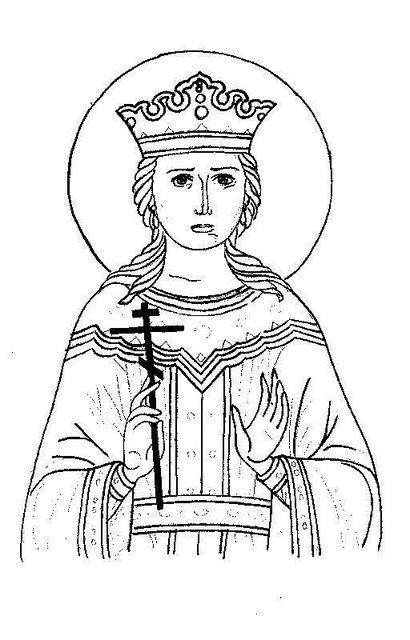
St. Olga, Royal Passionbearer


St. Olga, Royal Passionbearer
5" x 7", 2007
Acrylic and 23 karat gold on birch

Personal collection of Fr. Deacon James Blomeley

Posted by Picasa

Thursday, February 15, 2007

St. Thomas the Apostle


St. Thomas 5" x 7" acrylic on birch, 2007
~for Thomas on the occasion of his Chrismation~
Collection of Thomas Cole Andrews.

Posted by Picasa

Saint Justina


St. Justina 5" x 7" acrylic on birch, 2007

~for a dear goddaughter on the occasion of her Chrismation~

Collection of Justina Deborah Andrews.

Posted by Picasa

Saturday, December 16, 2006

St. Romanos the Melodist

Posted by Picasa St. Romanos the Melodist - 2006
acrylic on birch with 23 K gold leaf, 5" x 7"
private collection of Dr. Robert Harris

Saturday, November 25, 2006

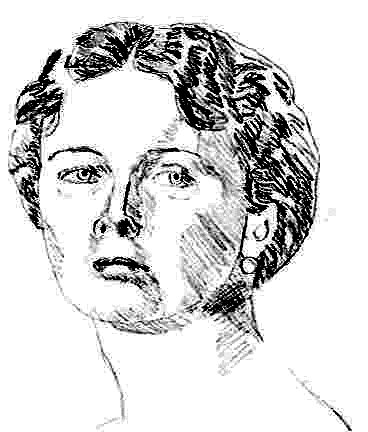
Grand Duchess Olga, Royal Passion-Bearer

A drawing done in research for a commissioned icon of the Grand Duchess Olga, Royal Passionbearer who was only 22 at the time of her murder by the Bolsheviks in 1918


Posted by Picasa

Saturday, November 11, 2006

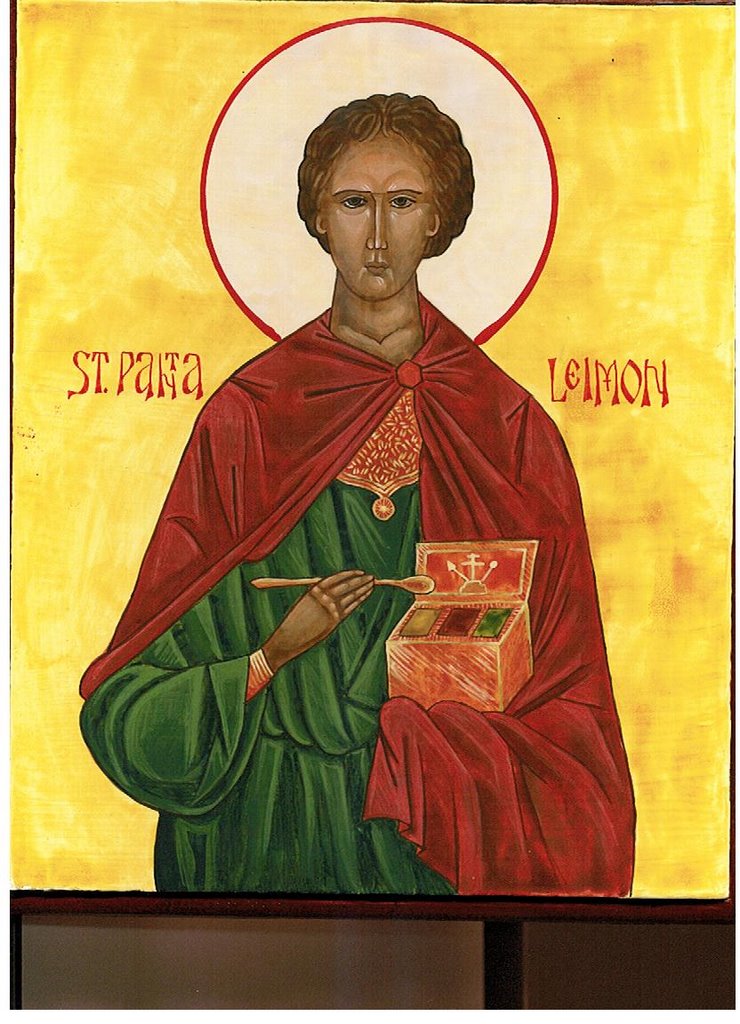
St. Pantaleimon the Unmercenary Healer


Posted by Picasa
St. Pantaleimon the Unmercenary Healer
8 1/2" x 10 1/2" acrylic on birch, 2006.
Collection of Joanna McMillan.

Monday, June 12, 2006

St. Heliena of Laureana


St. Heliena of Laureana - Holy Virgins Series
9 x 12", pen and ink on vellum
2006 - Collection of the artist
 Posted by Picasa